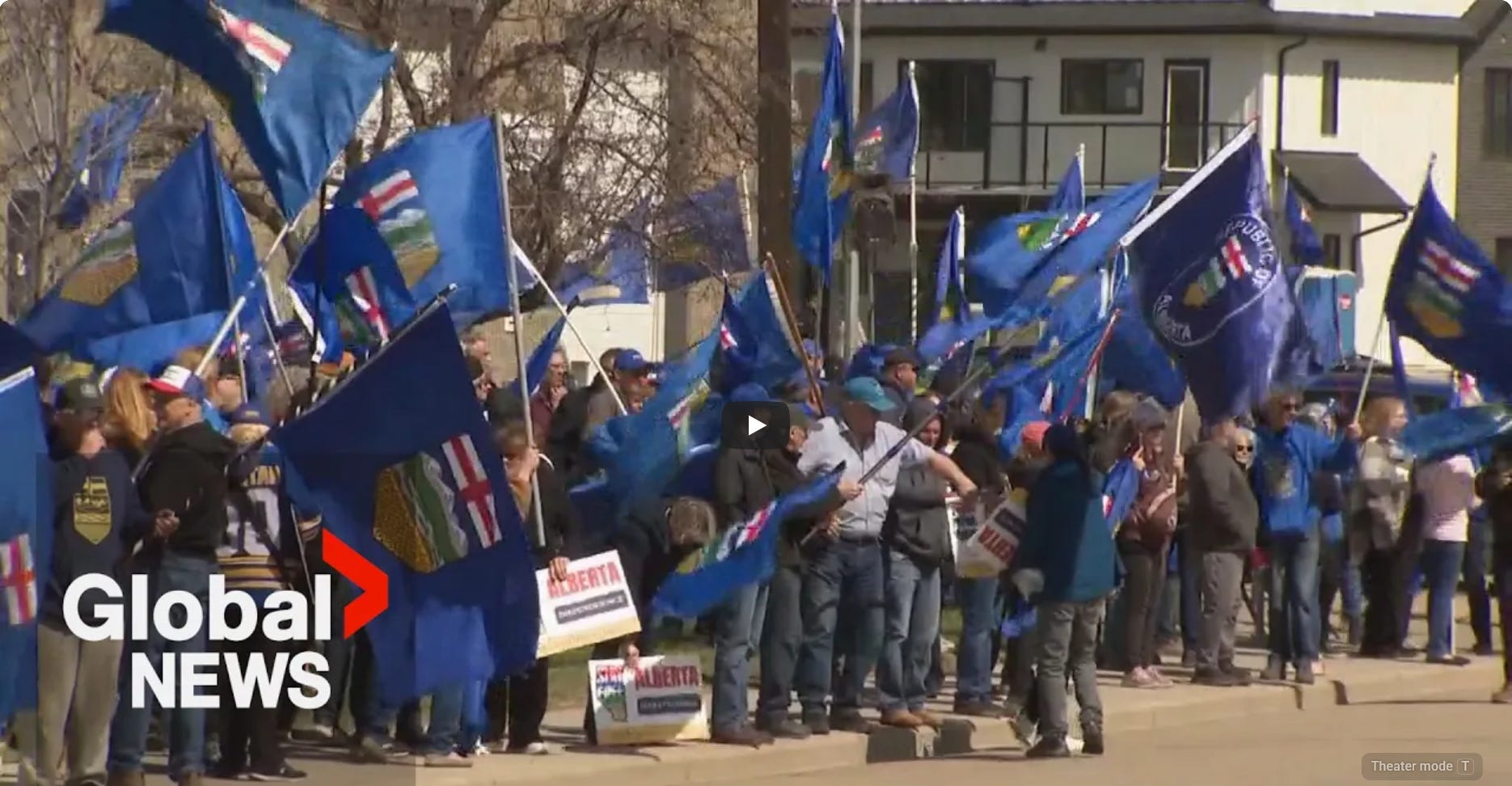
DEVON KRUGGEL -- Alberta Separatist petition turns in 300,000 signatures: Now what?
Is there a chance the separatists forces could win? The math clearly says no today.

I’m going to put this into perspective first. Former Alberta Deputy Premier Thomas Lukaszuk’s Forever Canadian petition turned in 456,000 signatures and 438,568 were deemed valid.
The Alberta separatists have turned in 300,000 and they need to have 177,732 be valid to meet the legal requirements to hold a referendum. Now before any one on their side celebrates there will be signatures on the petition that will be deemed invalid. This is why we have to wait for the review of the signatures to see if they actually meet the legal threshold.
It needs to be noted that Danielle Smith’s UCP government passed Bill 54 in 2025 altering the Citizen Initiative Act in 2025 to change the threshold from 20% of the voters to 10% of the voters. This gave the separatists an additional month as well. Anyone still think the United Conservative Party is loyal and patriotic?
Let’s say they hit the threshold.
There will be legal challenges from First Nations as to the legality of holding a referendum where lands involved are under Treaty. There are plenty of legal sticking points. The odds of a referendum this fall are still rather low.
Okay, let’s say they still manage to hold a referendum. What are their odds of winning? Is there a mathematical path to victory?
The math is very clear: there is not a single poll today that gives the separatist movement over 31% in favor of their position. When you dig into those numbers from some of the polls the situation changes.
In Alberta, according to pollster Ipsos there are three categories of separatist.
The first is the committed group. These are people that are ready to vote yes and leave Canada. They make up 56% of self identified separatists.
The second group are conditional separatists, and they are 25% of separatists. These are people that identify as separatists, but they would only vote to separate given a variety of conditions were met. You can call these people lukewarm separatists.
The final group are symbolic separatists, and they are not going to vote to separate. They make up 19% of all separatists. Symbolic separatists are poker players that are bluffing. They believe the threat of separatism is what is needed to get a better deal in Confederation.
This means that the referendum where the support was say the average of 27%, it would be more like 22% if we take the symbolic separatists out of equation. If we remove 50% of the conditional separatists, the Yes side is even weaker coming in at around 19%. Just to be transparent I have rounded all my numbers up to inflate the separatist position.
So, at 19%, based on the average support for separatism and using Ipsos’ numbers to see who would actually vote Yes, the math changes. And not for the better for the separatists.
When we circle back to the Forever Canadian petition we can see one thing very clearly: their side is very much more organized, much stronger, and would absolutely win a referendum.
Is there a chance the separatists forces could win? The math clearly says no today.
Here’s another good reason: there isn’t the same enthusiasm for separation as there is for staying in Canada. Both the separatist and Forever Canadian petitions operated under the same legal guidelines. The separatists turned in 300,000 signatures. Forever Canadian turned in 456,000 and had 438,568 as valid. We have yet to see how many of the separatist signatures survive review, but they could fall under the legal threshold and that would be the end of their movement for a few years. Or longer.
The separatists collected far fewer signatures which tells me, as a very long time political observer, that their movement has an extremely strong and devoted base. What it lacks is the broad public support it requires to actually succeed at the ballot box.
I think this is a fatal mistake for the movement moving for a referendum now.
They should have tested their movement at the next provincial election with an Alberta separatist party. There is such a party too and it is barely a blip on the polls. Actually, there are three such parties. They are the Wildrose Independence Party of Alberta, the Independence Party of Alberta, and the Republican Party of Alberta. That least one, the Republican Party is the only one to ever show any support on the polls at around 3%.
This tells us the movement isn’t unified or organized which further tells us a referendum on separation is going to have multiple conflicting voices trying to sell three or more different views of separation. That’s going to confuse voters and lead to an epic defeat at the ballot box.
In conclusion, Alberta separatists have likely reached for that brass ring only to set themselves up for a spectacular fall.
Devon Kruggel ... is a 52-year-old Caucasian male, who has lived in BC since 1990, and on Vancouver Island since 1993. According to Devon, he was a right winger of sorts from the age of 16 until he was about 47 or so. He has 2 Bachelors degrees; one in History and Political Science, and the other in Computer Science.